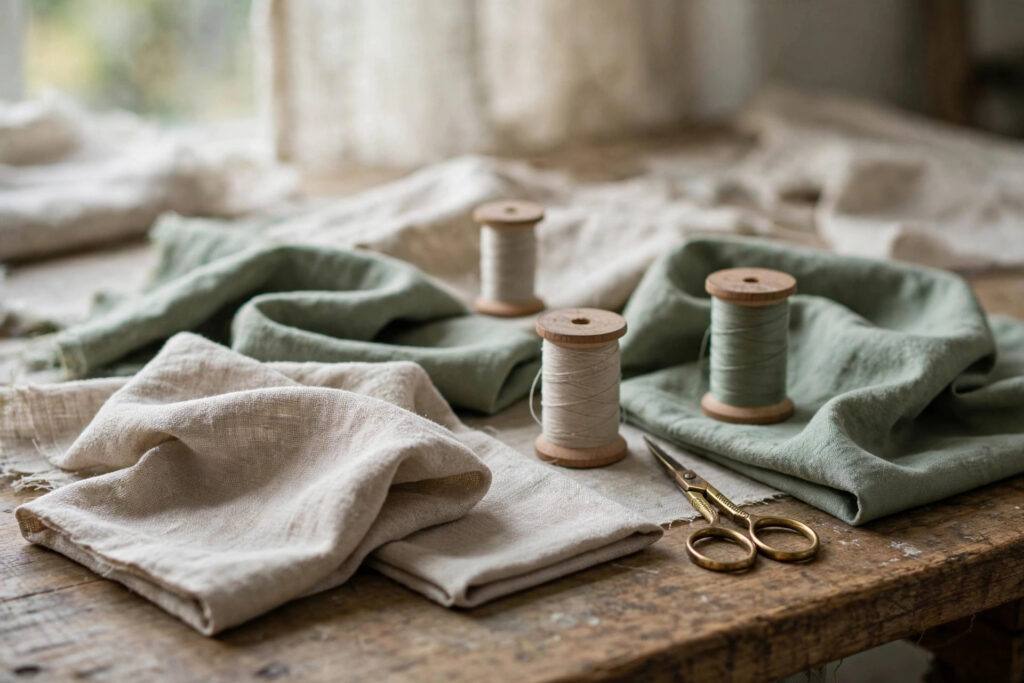
Linen vs cotton — which natural fabric suits your project? Pick linen when you want strength, breathability, and a fabric that improves with age: table linens, summer shirts, curtains, and hardworking home goods. Pick cotton when you need softness from day one, easy care, stretch recovery, and a lower price: quilting, baby clothes, everyday T-shirts, and fitted garments. Either way, pre-wash before you cut.
Most of us reach for one of these two fabrics without thinking. A linen shirt, a cotton tee, a cotton quilt, linen napkins at a good restaurant. They sit side by side in every fabric shop, and at a glance they even look related. But under the fingers they behave like different species entirely, because they are. One comes from the stalk of a flax plant pulled from damp northern fields. The other comes from the boll of a bush raised in hot, dry places. Everything about how they sew, wear, wash, and age follows from that origin. If you sew, quilt, weave, or simply buy fabric with intention, it helps to know the difference properly.
Two plants, two temperaments
Linen is the older textile. We have evidence of woven flax from caves in Georgia dating back some 36,000 years, and Egyptian tombs were stocked with linen fine enough to read through. The fiber comes from the inner bark of the flax plant — a tall, delicate blue-flowered crop that goes from seed to harvest in about 100 days. The stalks are pulled, not cut, then retted (rotted slightly, to loosen the fibers), scutched, and combed into long, silky strands. Almost the entire plant is used: fiber for cloth, seed for linseed oil and flaxseed, the woody shives for particle board or fuel. Very little goes to waste.
Cotton is the younger commercial giant but no less ancient — woven cotton fragments from the Indus Valley are about 7,000 years old. The fiber is the fluffy seed hair of the cotton boll, ginned from the seed and spun into yarn. A cotton crop takes 150 to 180 days to mature and drinks far more water: a single cotton shirt is estimated to carry roughly 2,700 liters of embedded water, against about 6.4 liters for a linen shirt. That doesn’t make cotton the villain of this story; it makes it the fiber whose supply chain you should read more carefully, especially conventional versus organic.
What the fibers actually do
Fiber structure is where the real argument happens, and linen wins most of it. Flax fibers are long — up to 90 centimeters in the best line flax — compared with cotton’s 2 to 5 centimeters. Longer fibers mean fewer joins in the yarn, fewer weak points, and that is why flax is commonly cited as roughly 30% stronger than cotton at the same weight. Here is the quirk that still surprises people: linen gets stronger when wet.
Moisture behavior separates them just as clearly. Flax has a moisture regain of roughly 9–12%, cotton about 8.5%, and linen cloth can absorb up to 20% of its weight in water before feeling damp. That is why linen feels cool and dry against skin in heat — it wicks sweat away and releases it fast — while cotton holds moisture closer to the body. The tradeoff is wrinkle. Linen’s long, stiff fibers have almost no elastic recovery, so creases set and stay. Cotton bounces back. A cotton shirt can come out of a drawer looking presentable; a linen shirt comes out of the drawer looking like it has opinions. Makers learn to treat that crease as texture, not failure.
Then there is aging. Cotton arrives soft and slowly thins, fades, and pills with washing. Linen arrives crisp — sometimes stiff enough to stand on its own — and softens with every wash while keeping its strength. A well-kept linen garment can be worn for 20 to 30 years; the fabric was literally designed by time to outlast fashion cycles. Upholstery workshops still prefer linen for heavy-use covers for exactly this reason.
At the cutting table: how they sew
On the sewing machine the two fibers announce themselves within the first seam. Linen frays with enthusiasm. Raw edges unravel fast, so finish them properly — French seams, bound edges, or a quick pass on the serger — or you will be sweeping threads off the floor. It presses like a dream, holds a crease beautifully, and feeds evenly under the presser foot. Cotton is the more forgiving beginner fabric: stable under the needle, easy to press, easy to unpick. The one cotton that fights back is lawn — fine, high-thread-count shirting cotton that slips and puckers like satin.
Both shrink, so pre-wash everything. Expect cotton to give up 3–5% in the first wash, more if it is a loose weave or knit. Linen is often sold unwashed and stiff; the first wash does the dramatic work of softening as well as shrinking. Wash it exactly as you will wash the finished piece, tumble or line dry the same way, and only then cut.
A quick weight guide in GSM
For shirting, look at linen in the 130–180 GSM range and cotton poplin or voile at 100–140. Quilting cotton typically runs 120–150 GSM; cotton canvas for bags and upholstery starts around 250 GSM and climbs past 400. When in doubt at the shop, scrunch the fabric in your fist: linen crackles and holds the crease, cotton springs back. That five-second test has settled a thousand purchasing debates.
The environmental ledger
For makers who care about footprint — and most of us do now — the numbers deserve a plain reading. Flax needs little irrigation, little or no pesticide, and returns organic matter to the soil when the leftover parts decompose. The plant absorbs CO2 as it grows, and the retting, scutching, and spinning are largely mechanical rather than chemical. Cotton’s footprint is heavier on the way in: irrigation, pesticides, and in some regions, the well-documented strain on freshwater sources. Processing both fibers into cloth, dyeing, and finishing are where the bigger industrial impacts live, so an undyed, minimally finished fabric of either fiber beats a heavily processed one.
Durability is the final line of the ledger. A linen garment that lasts three times longer than a cotton one spreads its production impact over three times the wearings. Cost per wear is how the old textile people thought about it, and it is still the right math.
Which fabric for which project
This is the part that matters at the fabric shop. Choose linen when the job is: table linens and napkins (it gets softer and more absorbent with use), summer shirts and dresses (nothing breathes like it), curtains (it filters light beautifully and hangs with relaxed weight), tea towels and aprons (strength plus absorbency), and tote bags or market bags (it outlasts cotton canvas in daily abuse). Heavyweight linen — 250 GSM and up — also makes superb upholstery and loose slipcovers.
Choose cotton when the job is: quilting (stable, cheap enough to buy in quantity, thousands of prints), baby and children’s clothes (soft from the first wear, survives hot washes), everyday T-shirts and underwear (knit cotton’s stretch recovery is unmatched by plain linen), fitted garments where you need the fabric to hold its pressed shape, and denim and twill bottoms (cotton’s diagonal twill structure is why your jeans survive). Muslin — unbleached plain-weave cotton — remains the standard for test garments and toiles because it is cheap, stable, and honest.
And the middle ground is wider than people think. A linen-cotton blend — commonly 55% linen, 45% cotton — gives you much of linen’s texture and breathability with cotton’s wrinkle forgiveness and lower price. For a first linen project, a blend is the sensible training wheel.
Caring for what you make
Linen care is simpler than its reputation. Machine wash warm with mild detergent, skip the bleach (it weakens the fibers), and line-dry when you can — sunlight keeps linen fresh and slightly bleaches out stains. Expect wrinkles; press while slightly damp if you want a crisp finish, or don’t. Never wring it hard; the wet strength is real, but wringing twists the yarns. Cotton is the easier houseguest: machine wash hot if you need to sanitize, tumble dry freely, pre-wash to kill shrinkage, and know that colors will fade a little faster than linen’s natural tones. Both fibers are fully biodegradable at the end of a long life, which is more than can be said for anything in the synthetic aisle.
Frequently asked questions
Is linen really stronger than cotton?
Yes. Flax fibers are roughly 30% stronger than cotton fibers — dry tenacity of about 0.4–0.6 N/tex versus 0.3–0.5 N/tex — and linen is unusual in that it grows stronger when wet. That is why linen tea towels, sheets, and upholstery survive decades of use.
Why is linen so much more expensive?
Three reasons: the fiber yield per hectare is lower than cotton, the processing (retting, scutching, combing) is labor-intensive and largely mechanical, and flax grows best in a narrow climate band — most of the world’s quality flax comes from France, Belgium, and the Netherlands. You are paying for labor, climate, and longevity. Measured in cost per wear over 20 years, linen often wins.
Can I use linen for quilting?
You can, and linen quilts are gorgeous, but go in with open eyes. Linen frays more, stretches a touch on the bias, and costs several times more than quilting cotton. Use a slightly larger seam allowance, finish your seams, and consider a linen-cotton blend for your first attempt.
Does linen shrink more than cotton?
Both shrink a similar amount in the first wash — roughly 3–5% — but linen is often sold unwashed, so the change feels more dramatic. Pre-wash linen exactly as you will wash the finished piece and the shrinkage stops being a problem.
Which is better for hot weather?
Linen, by a clear margin. Its long fibers wick moisture and release it quickly, and the typically open weave lets air through. Cotton is comfortable too, but it absorbs sweat and holds it against the skin longer, which is why a cotton shirt feels clammy where a linen one feels dry.
Cotton is the democratic fiber — affordable, soft, forgiving, endlessly printable, the right answer for half the projects in any sewing room. Linen is the patient one — demanding at the cutting table, stubborn about wrinkles, and quietly magnificent over the years. Buy cotton for the project you need next month. Buy linen for the project you want to still be using in ten years.
Comparing fabric listings from overseas sellers? Weights are often listed in oz/yd² instead of GSM — this fabric weight converter (GSM to oz/yd²) translates between the two, so the GSM ranges above are easy to check against any listing.
This article was created with AI assistance and reviewed by our editorial team before publishing.