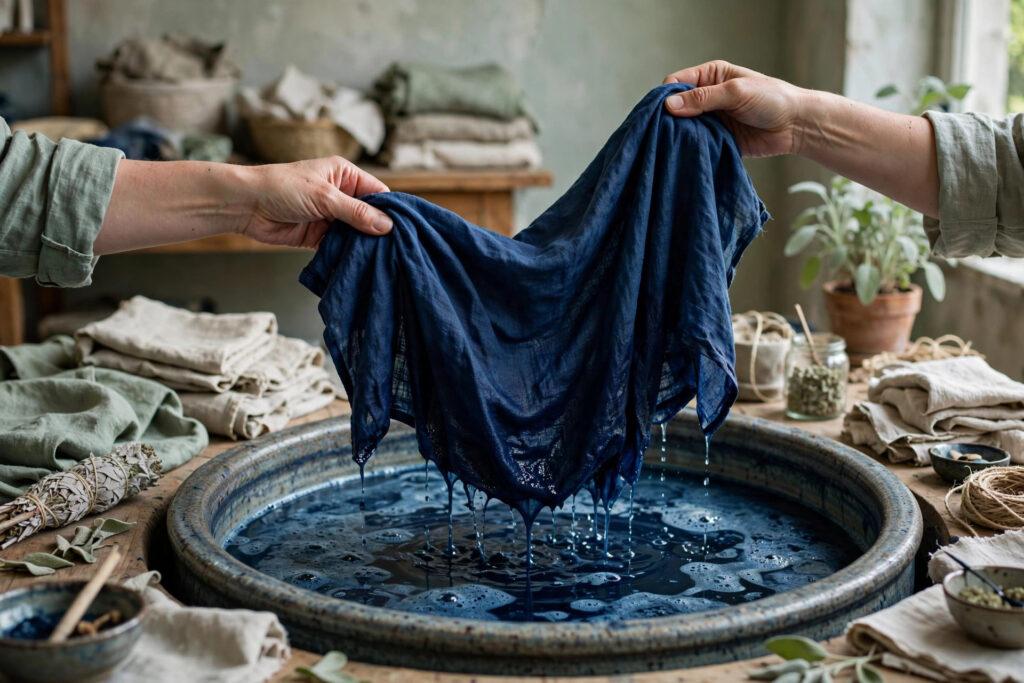
Indigo is a plant-based blue dye made from leaves that ferment into a greenish vat and turn cloth blue in open air. For centuries dyers in West Africa, India, and Japan shaped trade, clothing, and craft with it, long before it colored denim jeans worldwide.
That shift — green in the vat, blue in your hands — still feels a bit like magic. It isn’t. It’s chemistry, patience, and a lot of learned timing.
Dyers don’t force the color. They coax it. And once you understand that rhythm, you start to see why this one dye traveled so far and stayed so long.
How a Leaf Becomes Blue
Most natural indigo comes from plants in the Indigofera family, especially Indigofera tinctoria. According to the Royal Botanic Gardens, Kew, that species has been cultivated for dye in Asia for centuries.
The leaves don’t look blue at all. Workers harvest them, soak them, and let fermentation pull out a compound called indican. Air and agitation then help turn that extract into indigotin, the blue pigment itself.
Here’s the odd part. Indigotin won’t dissolve in plain water. Dyers have to reduce it in an alkaline vat, where it turns yellow-green and can slip into fiber. Pull the cloth out, and oxygen does the rest.
- The cloth goes in pale and wet.
- It comes out greenish, almost dull.
- Within minutes in air, it deepens to blue.
Want a darker shade? You dip again. And again. One dip gives you sky. Several dips can get you close to midnight.

A folded stack of indigo cloth shows how repeated dips build shade, from pale wash to deep navy.
West Africa: Cloth That Spoke
In West Africa, indigo wasn’t just decoration. It carried meaning. According to research published by the British Museum, indigo-dyed cloth in the region has long signaled wealth, skill, and social standing.
Yoruba dyers in what is now Nigeria became known for adire, a resist-dyed cotton made with starch paste or stitching. The Textile Museum in Washington, D.C. describes adire patterns as hand-drawn or stenciled before dyeing, so the covered areas stay light while the rest turns blue.
That’s slow work. Really slow.
A single cloth could pass through many hands — growers, dyers, pattern makers, traders. Each step added value. Each pattern told you something, too, about place and taste and who made it.
In Mali, dyers also worked with mud-resist and stitched resist techniques on cotton, according to the Smithsonian National Museum of African Art. The results look graphic and modern, even when the methods themselves are old.
Why Blue Held Status
Good indigo cloth took time, skill, and materials. It didn’t fade the way weaker dyes did. So it made sense as a store of value.
Traders moved it across markets. Families kept fine pieces for ceremonies. A deep, even blue said someone knew what they were doing — and could pay for it.
India and the Trade That Named a Color
The word itself points east. Historians of language trace “indigo” through Greek and Latin to a term meaning “Indian dye,” a derivation noted by the Oxford English Dictionary. The name stuck because India supplied so much of it to distant markets.
According to the Victoria and Albert Museum, India was a major center for indigo production and export for centuries, with dyed textiles and pigment cakes shipped to Europe and elsewhere.
Pigment traveled as hard, dried cakes. Cloth traveled too. European buyers wanted the blue because it was rich, fast, and hard to copy with local dyes like woad.
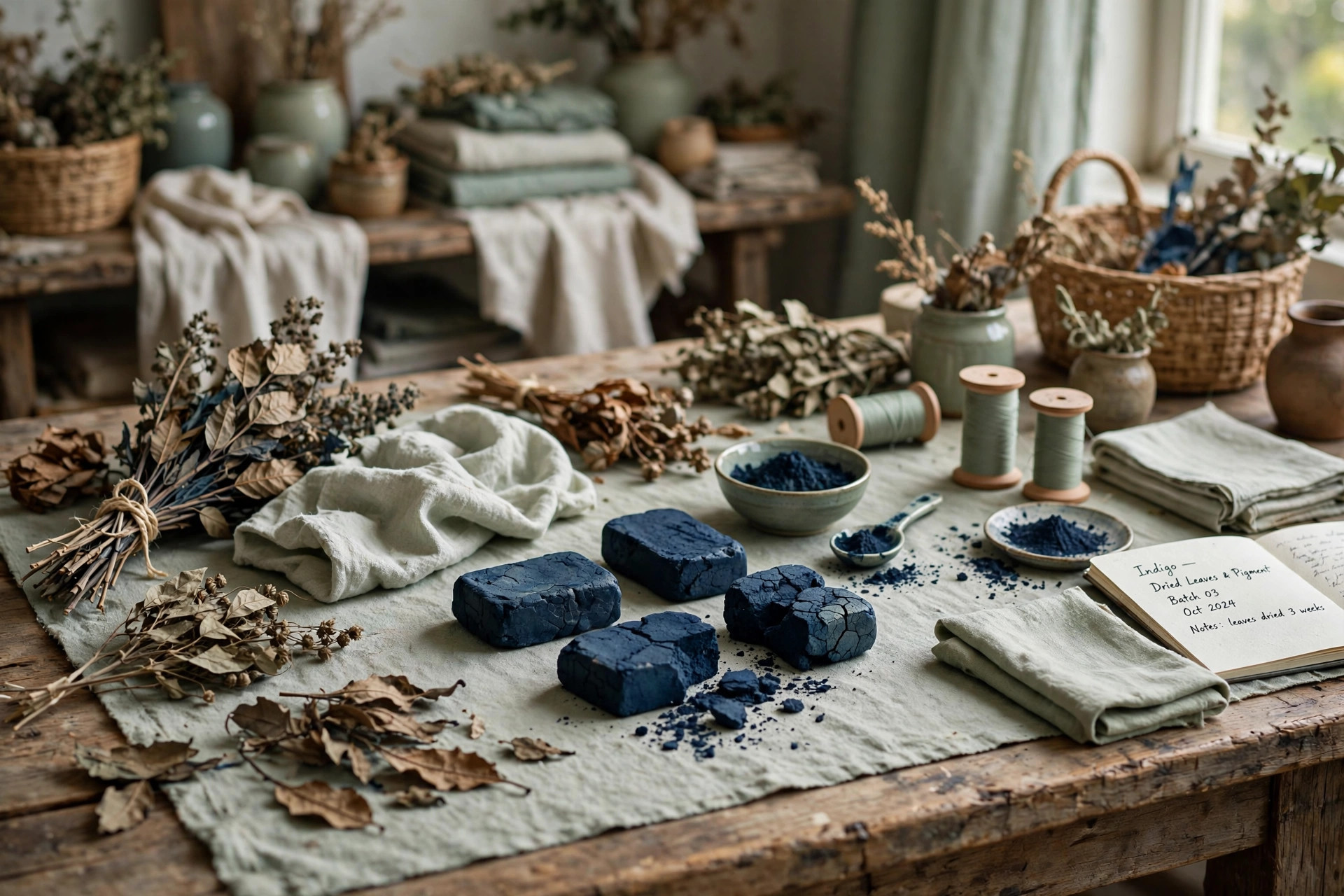
Dried indigo leaves and pigment cakes on a work table, the portable form that let blue cross oceans.
Woad could make blue, yes. But dyers in Europe often found indigo gave a stronger color from less material, according to dye histories summarized by the Victoria and Albert Museum. Stronger color meant better margins. It also meant pressure — on land, and on people.
You can’t tell this part honestly without saying it plainly. Colonial plantation systems in India and the Americas grew indigo under harsh, coercive conditions. Historians at the British Library document how indigo cultivation in Bengal sparked peasant protests in 1859, known as the Indigo Revolt. The dye is beautiful. Its trade history isn’t always.
Japan: Aizome and the Beauty of Repetition
Japan calls indigo dyeing aizome. The plant most closely linked to it there is Persicaria tinctoria, often called Japanese indigo. According to the Japan Folk Crafts Museum, aizome has deep roots in work clothing and household textiles.
Aizome vats are living things. Dyers feed them, stir them, rest them. A healthy vat smells earthy and shows a coppery sheen with blue bubbles — dyers call that bloom the “indigo flower,” a detail described by the Tokushima indigo museums in Japan.
Farmers and fishers wore indigo-dyed cotton for practical reasons. The cloth was sturdy. It could be re-dyed when it faded. And layers of dye built exactly the shades you still see in old work jackets and festival coats.
Then there’s shibori. You stitch, fold, clamp, or bind the cloth before it hits the vat. The tight spots resist the dye. Open it up and you’ve got waves, rings, speckles, sharp white lines against blue.
Simple tools. Endless results. That’s the appeal, isn’t it?
From Work Clothes to Denim Everywhere
So how did a dye tied to handwork end up on the world’s most common trousers?
Denim helps explain it. According to the Levi Strauss & Co. archives, the company patented riveted work pants with Jacob Davis in 1873, in the United States. Those early pants used sturdy cotton denim, and indigo became its signature color.
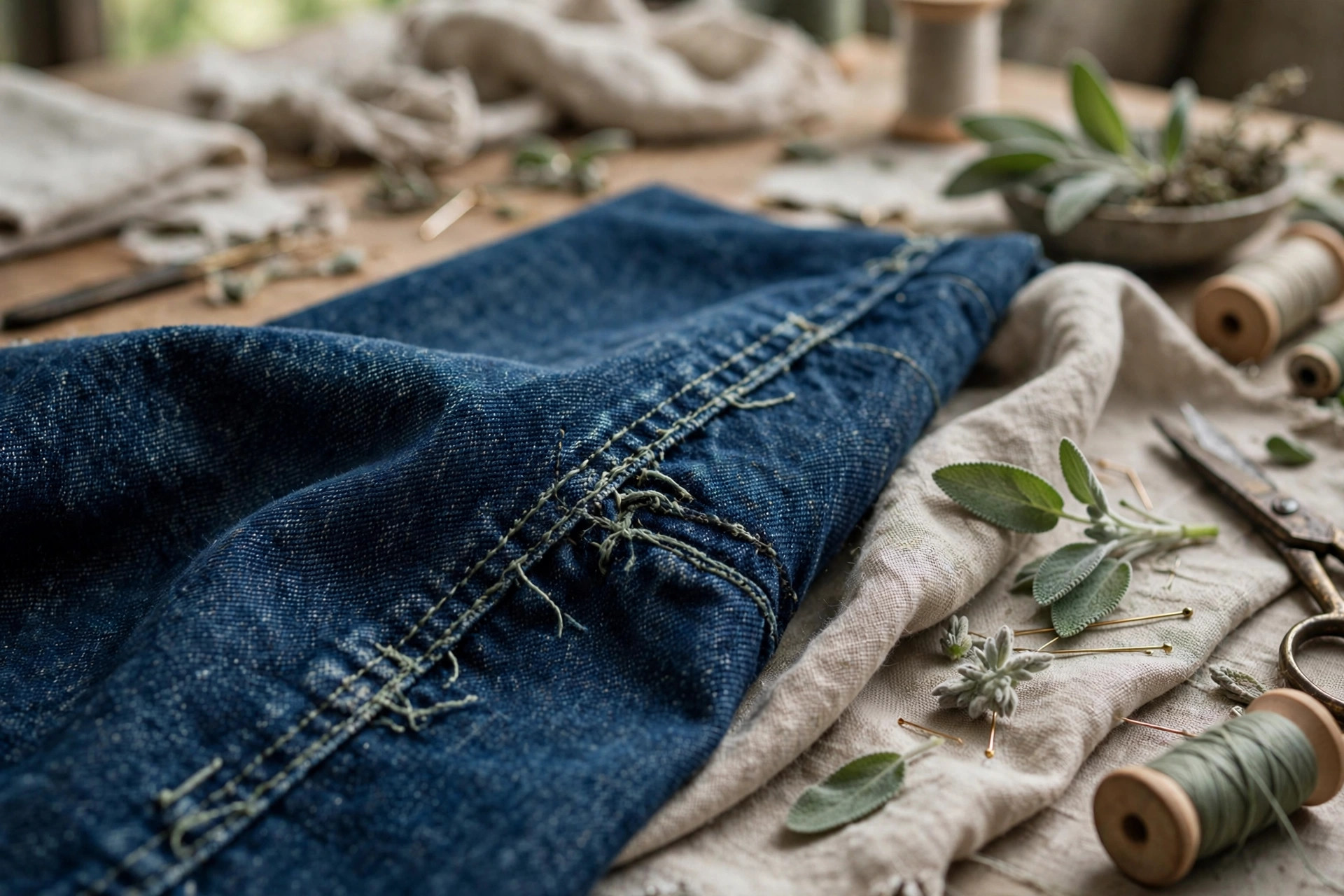
Indigo denim up close, where blue warp threads and pale weft create that familiar faded look.
Denim’s weave does something clever. In a classic denim twill, the warp threads are dyed indigo and the weft threads stay undyed or pale, a structure described by textile references at North Carolina State University’s Wilson College of Textiles. Rub the surface, lose a little surface color, and the lighter threads show through.
That’s why jeans fade the way they do. At your knees. At your pockets. Where you bend and sit and live in them.
Indigo also sits mostly on the surface of the yarn rather than soaking right through it — ring dyeing, dyers call it. That surface habit gives denim its slow, personal fade. No two pairs age alike.
A Color Workers Made Famous
Jeans started as workwear. Miners, ranch hands, factory staff — they needed cloth that could take a beating.
Film stars and teenagers later turned that workwear into style. But the blue came first, and it came from the vat, not from fashion.
Synthetic Blue Changed Everything
For most of its life, indigo depended on crops, seasons, and shipping. Then chemistry stepped in.
German chemist Adolf von Baeyer worked out indigo’s chemical structure in the late 19th century, work recognized in histories from the Nobel Prize organization, which notes he received the Nobel Prize in Chemistry in 1905 for work on organic dyes.
Making it in a lab was one thing. Making it cheaply, at scale, was harder.
According to standard histories of the chemical industry, BASF commercialized synthetic indigo in 1897 after years of costly research. That date changed the market. Plantation indigo, already under pressure, collapsed in many regions as factory-made dye took over.
Synthetic indigo is chemically the same blue molecule. Your eyes can’t tell the difference on cloth. But the supply chain flipped — from fields and fermentation pits to factories and patents.
Cheaper blue meant more blue. More denim, more workwear, more everyday clothing in that deep, forgiving shade. It democratized a color that had once been pricey. It also cut the link between dye and place.
Why Dyers Still Reach for the Vat
If factory indigo is cheaper and consistent, why bother with plants and vats at all?
Part of it is shade. Natural vats can give soft, shifting blues that feel alive on linen, cotton, and silk. Part of it is process. A vat asks you to slow down, watch, adjust. You can’t rush it and expect it to behave.
And part of it is continuity. When a dyer in Tokushima, Oaxaca, or Osogbo tends a vat today, they’re using gestures refined over generations — even if the cloth, the buyers, and the patterns have changed.
- Natural indigo suits small batches and one-off pieces.
- Repeated dipping lets you tune shade by eye, not by formula alone.
- Resist methods like shibori and adire still need that in-and-out vat rhythm.
None of that makes natural better by default. Synthetic has its place, and it made blue affordable for millions of people. But the vat never fully disappeared. It just moved — from mass trade to studios, workshops, and makers who want the process, not just the color.
Look closely at a hand-dyed scarf next to a fresh pair of jeans. Different worlds, right? Same blue thread runs through both.
Frequently Asked Questions
What plant does indigo dye come from?
Indigo dye comes from several plants, most famously Indigofera tinctoria in Asia and Persicaria tinctoria in Japan, according to the Royal Botanic Gardens, Kew. Dyers ferment the leaves to release the blue pigment, indigotin.
Why does indigo cloth turn blue only after leaving the vat?
Inside a reduced vat the dye is yellow-green and can enter the fiber. Once the cloth meets air, oxygen converts it back to blue indigotin. That color change in open air is a defining trait of vat dyeing.
When was synthetic indigo first sold commercially?
Synthetic indigo was commercialized by BASF in 1897, according to standard histories of the chemical industry. Factory production then undercut plantation indigo and reshaped the global dye trade within a few years.
Why do jeans fade in some spots faster than others?
Jeans fade because indigo sits mainly on the surface of the warp yarns in denim, as described by textile references at North Carolina State University. Friction wears that surface color away, revealing paler threads underneath.
What’s the difference between aizome and adire?
Aizome is Japanese indigo dyeing, often paired with shibori resist methods, while adire is a Yoruba resist-dyed cloth tradition from West Africa using starch paste or stitching. Both use indigo vats, but their patterns, tools, and cultural meanings differ.
This article was created with AI assistance and reviewed by our editorial team before publishing.